
guide · crochet terms · us terms · uk terms · crochet
UK and US crochet terms: how to read either one
By Elin · October 7, 2026
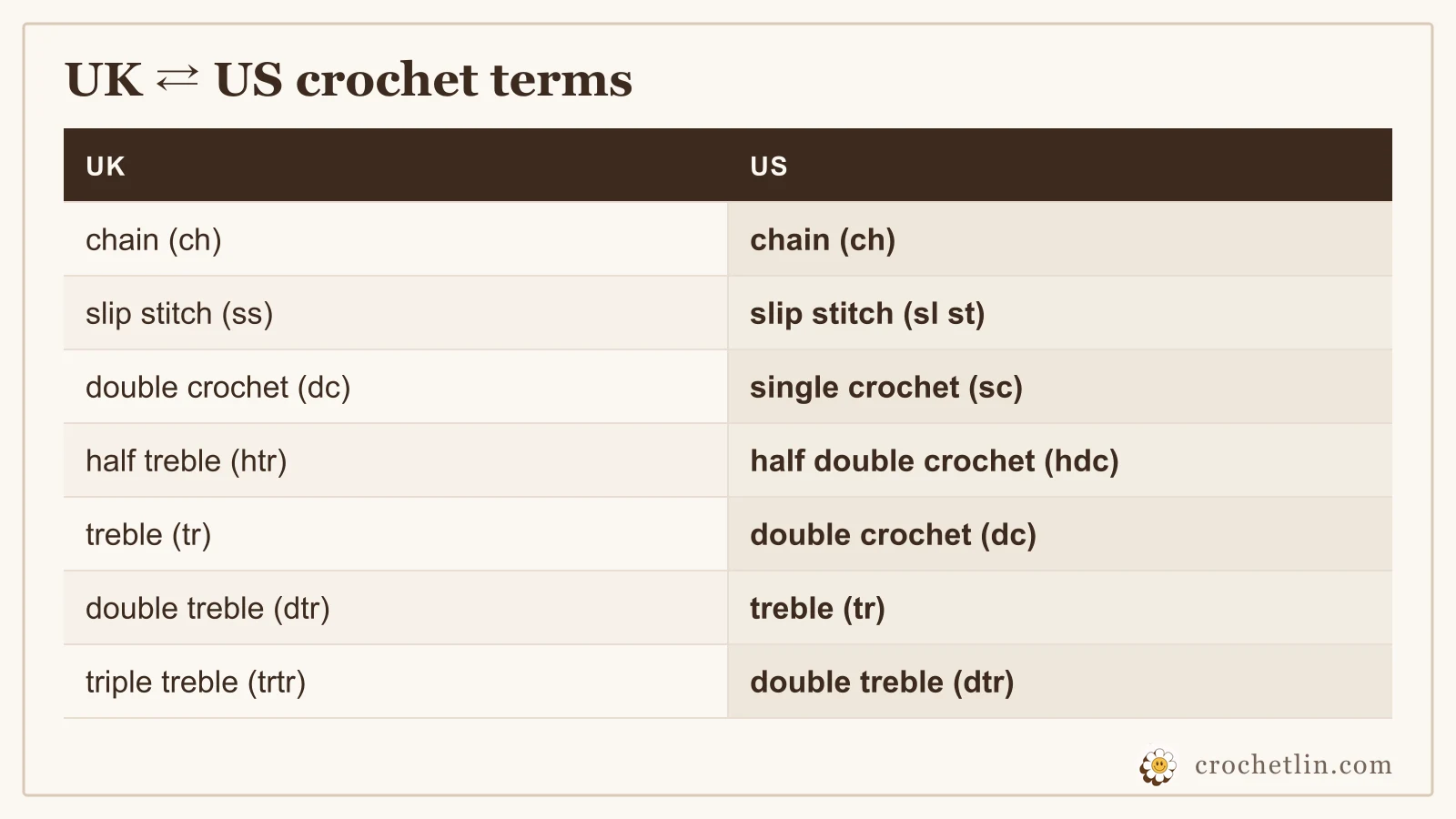
If you learned to crochet in Britain, an American pattern reads like your own language with the labels swapped. The words are all familiar. They just point at different stitches. A UK double crochet and a US double crochet are not the same thing, and nearly every question I get about my English patterns comes back to that one overlap.
It sounds worse than it is. Here is the whole difference.
The names are offset by one
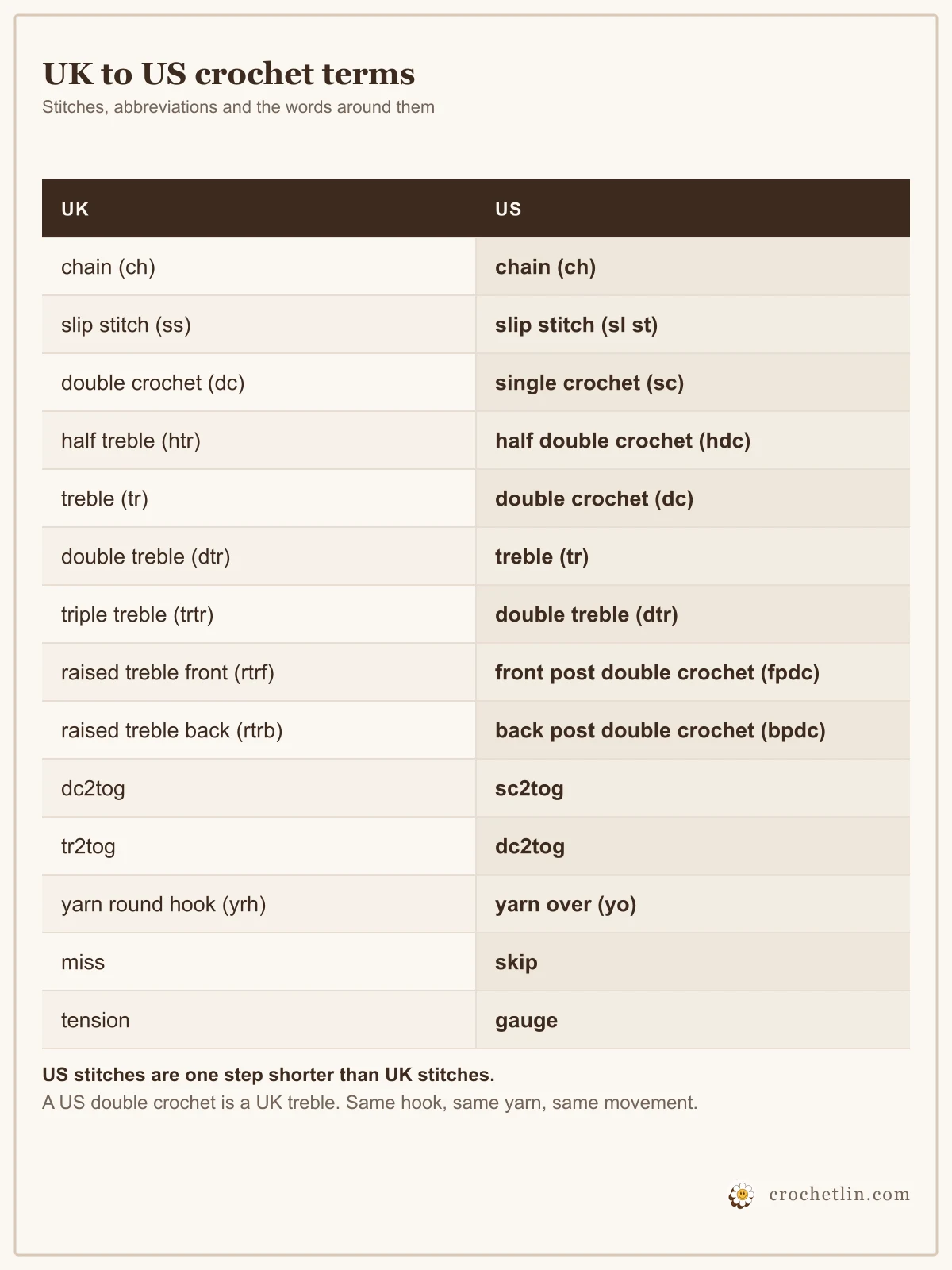
Every US stitch name sits one step below its British twin. What Britain calls a double crochet, America calls a single crochet. What Britain calls a treble, America calls a double crochet. Keep going down the list and the pattern holds the whole way up.
That is the entire rule. The stitches themselves are identical. Same hook, same yarn, same movement of your hands. Nobody crochets differently in Leeds than in Chicago. Only the names moved.
If you remember one line, make it this one: a US double crochet is a UK treble. Everything else falls into place around it.
The chart
How to tell which terms a pattern uses
- Look for single crochet. That stitch only exists in US terms. If sc appears anywhere, you are reading American.
- Look at the shortest stitch. If the smallest stitch in the whole pattern is a double crochet, the pattern is British. In an American pattern, a double crochet is one of the taller stitches.
- Read the words around the stitches. American patterns say gauge, yarn over and skip. British ones say tension, yarn round hook and miss.
Most designers also state it at the top of the pattern. I do, and it is on the product page before you buy.
The other words that change
Stitches get all the attention, but a handful of other words differ too. Gauge and tension are the same thing: your swatch. Yarn over and yarn round hook are the same movement. Skip and miss both mean leave that stitch alone.
Hook sizes are the last trap. American patterns often give a letter, like H/8, where British patterns give millimetres. Mine give millimetres, so there is nothing to convert.
You are not learning to crochet again
This is the part I want to say plainly, because it is what stops people buying. Your hands already know every stitch in that chart. Nothing about the movement changes because the stitch goes by another name. What you are learning is a second label for something you can already do, and it takes about one row.
If it feels muddled, try this: read through the pattern's stitch list before you start and pencil the British name next to each one. After two rows you will stop looking at the margin.
Why my patterns use US terms
Most of the crochet world writes in US terms, so that is where I write. But every step in my patterns is photographed, and that is the point here: even when a name is new to you, the photo shows what the stitch should look like. You never have to work it out from the word alone.
And if something still does not look right, write to me and we will sort it out.
Where to go next
If you want the stitches themselves rather than their names, the guide to the six basic stitches goes through each one with a photo. And when you are ready to put them to work, the patterns are here.